

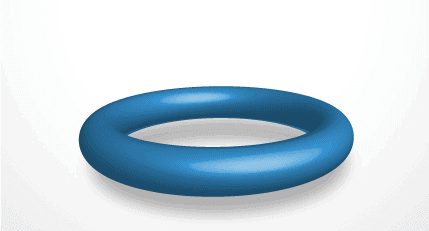
Fluorocarbon (FKM) Rubber
Description:
Fluorocarbon is a well-known high performance rubber that has excellent resistance to high temperature, ozone, weather, oxygen, mineral oil, fuels, hydraulic fluids, aromatics, and many organic solvents and chemicals.
Viton™ fluoroelastomers fall into these different categories:
- A-TYPE, 66% fluorine
- B-, GBL-TYPE, 67~68.5% fluorine
- F-, GF-TYPE,70% fluorine
- GLT, GFLT
- Viton™ ETP Extreme
Viton™ ETP Extreme offers a higher level of resistance to more chemicals and solvents.
Common Uses:
FKM is found in:
- Chemical processing
- Aerospace applications
- Industrial applications
- O-rings
- Automotive applications
Properties:
Standard Compound: -26°C (-15°F) to 205°C (401°F)
Special Compound: -40°C (-40°F) to 230°C (446°F)
Hardness: 50 to 90 Shore A
ASTM D1418 Designation: FKM
ASTM D2000 Designation: HK
Standard Colors: Black
Optional Colors:
Production:
Standard FKM compounds are Bisphenol cured. FKM compounds that are peroxide cured possess better resistance to acid solutions, and can replace those that are litharge cured in an acid solution.
Advantages:
FKM rubber compounds perform well in petroleum products, fuels or blends with methanol or ethanol, diesel or blends with biodiesel, mineral oil and grease, silicone oil and grease, high vacuum environments, ozone, strong acids.
Limitations:
FKM rubber compounds are susceptive to amines, ketones, formic and acetic acids, nitro hydrocarbons, superheat steam, low molecular weight esters and ethers, hydrofluoric, chlorosulfonic acids at high heat, Skydrol® fluids, and phosphate ester based hydraulic fluids.
Viton™ Product Comparison:
|
Viton™ Product |
A |
AL |
B |
F |
GAL-S |
GBL-S |
GF-S |
GLT-S |
GBLT-S |
GFLT-S |
TBR-S |
ETP-S |
|
bisphenol |
bisphenol |
bisphenol |
bisphenol |
peroxide |
peroxide |
peroxide |
peroxide |
peroxide |
peroxide |
bisphenol |
peroxide |
|
|
Fluorine Content |
66% |
66% |
68.5% |
70% |
65.5% |
67.5% |
70% |
64.5% |
66% |
67% |
60% |
66% |
|
Heat Resistance |
All Viton™ products have outstanding thermal properties |
|||||||||||
|
Chemical Resistance |
Fair |
Fair |
Good |
Very Good |
Good |
Good |
Very Good |
Fair |
Good |
Very Good |
Fair |
BEST |
|
Base Resistance |
Poor |
Poor |
Poor |
Poor |
Fair |
Fair |
Fair |
Good |
Good |
Good |
BEST |
BEST |
|
Low Temperature Properties |
Good |
Very Good |
Good |
Fair |
Very Good |
Good |
Fair |
BEST |
Very Good |
Very Good |
Poor |
Fair |
|
Compression Set Resistance |
BEST |
Very Good |
Very Good |
Good |
Very Good |
Very Good |
Very Good |
Very Good |
Very Good |
Very Good |
Good |
Good |
|
Relative Cost of Polymer |
Low |
Low |
Low |
Low |
Low |
Low |
Low |
Medium |
Medium |
Medium |
Low |
High |
Frequently Asked Questions About FKM Fluoroelastomer Rubber
What is FKM rubber?
Fluoroelastomer rubber, or FKM, is a high-performance synthetic
elastomer. It is based on copolymers of vinylidene fluoride combined
with monomers such as HFP, TFE, or PMVE.
FKM provides excellent resistance to high temperatures, aggressive
chemicals, fuels, oils, and harsh operating environments. It is
designated FKM under ASTM D1418 and classified HK under ASTM D2000.
What makes FKM different from standard rubber materials?
FKM offers greater resistance to heat, ozone, weathering, oxygen,
mineral oils, fuels, hydraulic fluids, and many organic solvents.
These properties make it suitable for demanding applications such as
automotive fuel systems, chemical processing equipment, aerospace
components, and high-temperature industrial machinery.
What is Viton™ and how is it related to FKM?
Viton™ is a brand of fluoroelastomers originally developed by DuPont
and now owned by Chemours. Every Viton™ material is an FKM grade,
but not every FKM material is Viton™.
Other FKM polymer brands include Dyneon from 3M, Tecnoflon from
Solvay, and Dai-El from Daikin. SKF and Greene Tweed are sealing
product manufacturers, rather than FKM polymer brands.
Chemours also manufactures Kalrez®, which is an FFKM
perfluoroelastomer. FFKM is a different and more advanced material
class than Viton™ FKM.
Techno Ad has served as an authorized Chemours distributor in Israel
since 2011. We stock major Kalrez® grades, including 6375, 0040
Sahara, and Spectrum 7090, together with standard AS568 O-rings.
Minimum order quantities are determined according to the requested grade.
What are the different types of Viton™ and FKM grades?
Common FKM types and Chemours grades include:
- A-Type: 66% fluorine, standard and economical, including Viton™ A-401C
- B-Type: 68% fluorine, with improved chemical and fluid resistance, including Viton™ B-202 and B-601C
- F-Type: 70% fluorine, with superior fuel and methanol resistance, including Viton™ F-605C
- GLT and GLT-S: low-temperature grades with typical published TR-10 values around -30°C
- GFLT and GFLT-S: low-temperature grades with added fuel and chemical resistance, with typical TR-10 values around -24°C
- ETP and ETP-S: extended chemical resistance, including resistance to certain acids, aldehydes, and ketones
TR-10 is a low-temperature retraction test value. It is not a
guaranteed sealing temperature. Final grade selection should consider
the compound, cure system, chemical exposure, temperature, and actual
service conditions.
What is the operating temperature range of FKM?
The operating range varies considerably between grades. The following
figures provide general guidance rather than fixed specifications:
- A-Type FKM: approximately -15°C to +204°C, with short excursions toward +230°C
- B-Type FKM: approximately -18°C to +210°C
- GLT: typical published TR-10 values around -30°C
- GFLT: typical published TR-10 values around -24°C
- ETP: an upper range similar to standard FKM, with improved chemical rather than temperature resistance
Standard FKM is generally described as suitable for continuous service
between approximately -15°C and +204°C. It is not suitable for
cryogenic applications. VMQ silicone or specialty FVMQ may be more
appropriate for extremely low temperatures.
Actual limits depend on the grade, compound, cure, post-cure,
exposure time, and media. Always confirm the range against the
compound datasheet and real operating conditions.
What are common applications of FKM rubber?
FKM rubber is commonly used for:
- Automotive fuel-system O-rings and seals
- Components exposed to gasoline, diesel, and E85
- Chemical processing equipment seals
- Aerospace engines and fuel systems
- Oil and gas downhole tools
- NORSOK M-710-qualified sealing applications
- Semiconductor processing equipment
- High-temperature industrial machinery
- Static and dynamic O-rings in harsh environments
What substances is FKM resistant to?
FKM generally performs well when exposed to:
- Petroleum products and hydrocarbon fuels
- Gasoline, diesel, methanol, and ethanol blends
- Biodiesel and other biofuels
- Mineral and silicone oils and greases
- High-vacuum environments
- Ozone, ultraviolet radiation, and weathering
- Certain strong acids under defined conditions
Acid resistance is not identical across all FKM materials. It depends
on the FKM type, cure system, acid concentration, temperature, and
exposure period. Compatibility must be confirmed for the specific
compound and service conditions.
What are the main limitations of FKM rubber?
Standard FKM is generally unsuitable for:
- Amines such as ammonia and ethylenediamine
- Ketones such as acetone and MEK
- Formic and acetic acids
- Nitro hydrocarbons
- Superheated steam above approximately 150°C
- Low-molecular-weight esters and ethers
- Phosphate ester hydraulic fluids such as Skydrol
EPDM is usually preferred for phosphate ester fluids. FFKM materials
such as Kalrez® or certain ETP grades may be considered for amines,
ketones, and other aggressive chemicals.
Viton™ Extreme ETP offers improved resistance to certain
low-molecular-weight acids, aldehydes, and ketones. However, published
results apply to specific compounds and test conditions. Compatibility
must still be verified for the actual media and temperature.
How is FKM rubber typically cured?
Most standard FKM compounds use a bisphenol cure system. This method
provides excellent compression-set performance and heat resistance.
Peroxide-cured FKM can provide better resistance to acidic environments,
hot water, and steam. Older litharge-cured systems using lead oxide
have largely been replaced because of environmental concerns.
Does FKM require post-cure?
Post-curing is common and often required during FKM processing, but
it is not universal. The requirement depends on the compound, cure
system, and intended application.
Bisphenol-cured compounds intended for demanding sealing applications
normally require post-curing. When required, a typical process uses
a forced-air oven at approximately 200°C to 250°C for several hours,
according to the compound supplier’s instructions.
Omitting a required post-cure can leave compression set, tensile
strength, and chemical resistance below the specified levels.
Is FKM suitable for Rapid Gas Decompression (RGD/AED)?
Standard FKM has moderate susceptibility to Rapid Gas Decompression,
also known as Explosive Decompression, during high-pressure gas service.
Severe applications, including oil and gas downhole equipment and
hydrogen service, require RGD-qualified compounds tested according
to standards such as NORSOK M-710 or ISO 23936-2.
Certain FFKM materials, including Kalrez® LS-Series grades, may
provide better RGD performance in demanding environments.
How does fluorine content affect FKM performance?
Higher fluorine content generally improves fuel and chemical resistance.
However, it can reduce low-temperature flexibility and increase material
costs.
- 66% fluorine: better low-temperature performance and lower cost, commonly found in A-Type FKM
- 68% fluorine: balanced performance, commonly found in B-Type FKM
- 70% fluorine: improved fuel resistance, commonly found in F-Type FKM
For Kalrez® FFKM applications, service temperature and chemical
resistance vary by grade. The widely quoted maximum of 327°C applies
only to specific high-temperature Kalrez® grades, rather than the
entire material family.
Techno Ad is an authorized Chemours distributor in Israel. We hold
regional stock of major Kalrez® grades and standard AS568 O-rings,
while our engineering team supports grade and compound selection.