What is Chloramine?
Chloramine is a disinfectant used in drinking water systems. Technically, chloramines are formed when ammonia is added to chlorine, usually as monochloramine (NH₂Cl).
Unlike “free chlorine,” chloramine offers a more stable disinfectant residual that can persist as water travels through long distribution networks before reaching consumers.
Why Use Chloramine – Not Just Chlorine?
Historically, water systems used free chlorine (e.g. chlorine gas, hypochlorite) for disinfection, which is rapidly effective at killing pathogens. However, free chlorine is a strong oxidizer and can react with organic matter in water to produce disinfection by-products (DBPs), such as trihalomethanes (THMs), which have been associated with health risks.
To reduce the formation of these potentially harmful byproducts while still providing residual disinfection throughout the distribution network, many water utilities turned to chloramines. Chloramine is less reactive than free chlorine, leading to significantly less THM formation and fewer taste or odor problems often associated with chlorine byproducts.
Moreover, chloramine’s greater chemical stability helps it remain effective longer, important for maintaining microbial safety as water travels across long pipelines, storage tanks, and distribution systems.
Thus, switching to chloramines helps balance effective disinfection with lower DBP formation, a tradeoff many modern water utilities consider worthwhile.
When You Need Chloramine and What That Means for Materials
If a water supply uses chloramines for disinfection, especially as a secondary disinfectant (i.e. residual protection through the network), then the materials used in that system must be compatible with chloraminated water. That includes pipes, fittings, valves, and critically: seals, gaskets, O-rings, diaphragms, the elastomeric components that prevent leaks and maintain water-tight integrity.
As a materials or product engineer designing plumbing fixtures, water treatment devices, faucets, or any potable-water handling system, it is vital to recognize that standard rubber compounds (especially those cured via sulfur vulcanization) may degrade over time when exposed to chloramine — leading to swelling, cracking, loss of elasticity, leaks, or even disintegration.
Therefore, in any water system where chloramine is used, or may be used in the future, it’s prudent to specify chloramine-resistant elastomers from the design phase.
Disinfection Technique for Seals – The Problem with Chloramine Exposure
Because chloramine remains in the water as a persistent residual, elastomeric seals and gaskets remain in constant contact with an oxidative chemical environment. Over time, this exposure can degrade the physical properties of regular rubber seals:
- Loss of tensile strength or elasticity.
- Swelling or volumetric expansion, which can over-stress sealing glands and compromise sealing performance.
- Surface cracking, softening, discoloration or even degradation into particulate debris that could affect water quality.
In real applications, this often leads to premature seal failure, leaks, maintenance costs, and potentially contaminants or particulates in the water, which defeats the purpose of using chloramine for water quality in the first place.
Hence, there has to be seals designed specifically to resist chloramine effects.
Chloramine-Resistant Rubber Seals: What Works?
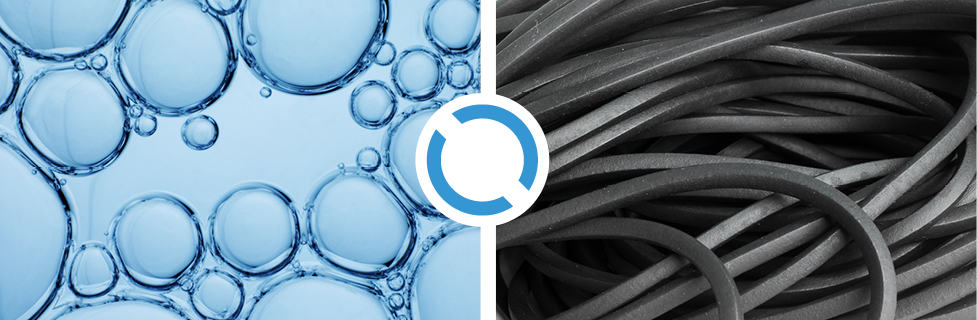
Fortunately, material science and elastomer engineering have advanced to offer viable solutions. Elastomer compounds cured via peroxide (instead of sulfur), such as peroxide-cured EPDM, peroxide-cured silicone, or certain peroxide-cured fluorocarbon rubbers (e.g. Viton™ FKM), show far better stability in chloraminated water.
Manufacturers and suppliers who formulate chloramine-resistant rubber compounds typically customize the base polymer with additives optimized for chloramine resistance, heat resistance, and long-term dimensional stability.
Empirical evidence highlights the difference: In one independent test (following the standardized test procedure of ASTM D6284), samples of traditional rubber showed severe swelling or degradation after exposure to a 50 ppm chloramine solution at 70 °C for a period of weeks. In contrast, chloramine-resistant formulations showed minimal or negligible change under the same conditions.
Thus, chloramine-resistant elastomers offer significantly longer useful seal life, reducing maintenance needs, warranty claims, and, crucially, minimizing the risk of particulate contamination or seal failure.
ASTM D6284 – The Engineering Standard Behind Material Selection
ASTM D6284 is the recognized standard test method for evaluating how vulcanized rubber performs when exposed to aqueous chlorine or chloramine solutions.
Under ASTM D6284:
- Rubber specimens (dumbbell or ring-shaped) are immersed in a solution with ~ 50 ppm available chlorine or chloramine.
- The exposure runs at elevated temperature (typically 70 °C) for a defined number of days.
- After exposure, samples are examined for changes: weight gain or loss, swelling, hardness (durometer) changes, surface cracking, loss of elasticity or mechanical strength.
By comparing these parameters before and after exposure, and comparing across different elastomer compounds, engineers can qualify which materials are actually “chloramine-resistant.” This provides a standardized, reproducible method to compare materials, validate designs, and ensure long-term durability in chloraminated water environments.
For manufacturers or product engineers designing potable-water seals, valves, faucets, or plumbing fixtures, specifying that seals comply with ASTM D6284 and are certified for chloramine exposure is not just good practice, it is essential for long-term reliability.
Why Chloramine-Resistant Seals Improve Long-Term Water Quality
Using chloramine-resistant seals is not merely about durability or reduced maintenance, it also contributes directly to water quality and safety in the long term:
- Reduced leaks and failures: Elastomers that resist chloramine degradation maintain their sealing integrity, preventing leaks that could compromise water pressure or lead to increase of contaminants.
- Avoidance of particulates: Rubber degradation can shed particles (“black flakes” or debris) into water, which can be flushed into taps, water heaters, shower heads, or appliances. By using stable materials, you prevent such contamination.
- Consistent chemical resistance: As chloramine remains present throughout the distribution system, seals designed for chloramine ensure long-term compatibility – no unexpected premature failure even after months or years of exposure.
- Lower maintenance, fewer replacements: Less frequent replacement of seals means less risk of human error, reduced downtime, reduced material waste, and more stable water quality over time.
From an engineer’s perspective, designing for chloramine resistance from day one is a preventative strategy: you eliminate a known failure mode, avoid compromising water quality, and ensure that the water delivery system lives up to its promise of “safe, clean, potable water”, not only at install but for the entire lifecycle.
Conclusion
As water utilities increasingly adopt chloramines (rather than free chlorine) for more stable, long-lasting disinfection with fewer harmful by-products, engineers and product designers must adapt accordingly. That means rethinking material selection, especially for rubber seals and gaskets, and moving away from standard sulfur-cured elastomers toward “chloramine-resistant” formulations.
By specifying peroxide-cured EPDM, silicone, or fluorocarbon rubber, and qualifying them via standardized testing under ASTM D6284, you ensure longevity, reliability, and water quality. Using chloramine-resistant seals is not just good design, it’s a key part of delivering safe and sustainable potable water systems.
At Techno Ad, we believe that this engineering, combining material science, standardized testing, and practical design, is essential for modern water infrastructure. If your project involves chloraminated water, investing in chloramine-resistant rubber seals is not optional, it’s fundamental.
Ready to engineer longer-lasting, safer water systems?
Talk to the Techno Ad team about chloramine-resistant rubber seals and custom elastomer solutions. Our engineering-driven approach helps you design products that last longer, perform better, and protect water quality over time.
Contact us today to discuss your application: https://www.technoad.com/